If you use Bitcoin but still pay expenses in dollars, you may want to keep part of your money in USDT or USDC without leaving it on an exchange. Can you hold those stablecoins in the wallet you already use for BTC, and keep control of the funds yourself?
Holding Bitcoin and stablecoins in the same wallet is possible, as long as the application supports their respective networks. You can then manage a dollar balance alongside your BTC without handing the keys to a centralized exchange or custodian, although the stablecoins still have their own receiving instructions and transaction fees.
Can your Bitcoin wallet hold stablecoins?
The confusion often comes from what we call a Bitcoin wallet. Some applications only manage BTC, while others let you access several blockchains from the same interface. With the latter, you can hold Bitcoin alongside Tether USD (USDT), issued by Tether, and USD Coin (USDC), issued by Circle, even though those assets circulate on different networks.
For example, your wallet might manage BTC on Bitcoin and USDC on Ethereum. You would see both balances in the application, but you would still need to select the Ethereum account to receive that USDC. Sending it to your ordinary Bitcoin address would not work, just as displaying the balances together does not make them interchangeable.
Hardware wallets such as Ledger, Trezor and BitBox Multi can secure the keys for Bitcoin and Ethereum-based stablecoins, with support depending on the model, firmware and companion application. If you already own a device, check its exact edition before buying another wallet. BitBox's Bitcoin-only editions, for instance, cannot manage the stablecoins supported by its Multi editions.
You can also use a browser extension. MetaMask supports Bitcoin and other networks, whereas Rabby focuses on Ethereum and compatible chains, so it can manage your stablecoins alongside a separate Bitcoin wallet. Both can connect to compatible hardware wallets, letting you use the extension as an interface while the device keeps the keys. To connect them, use the hardware-wallet option rather than entering the device's recovery phrase into the browser.
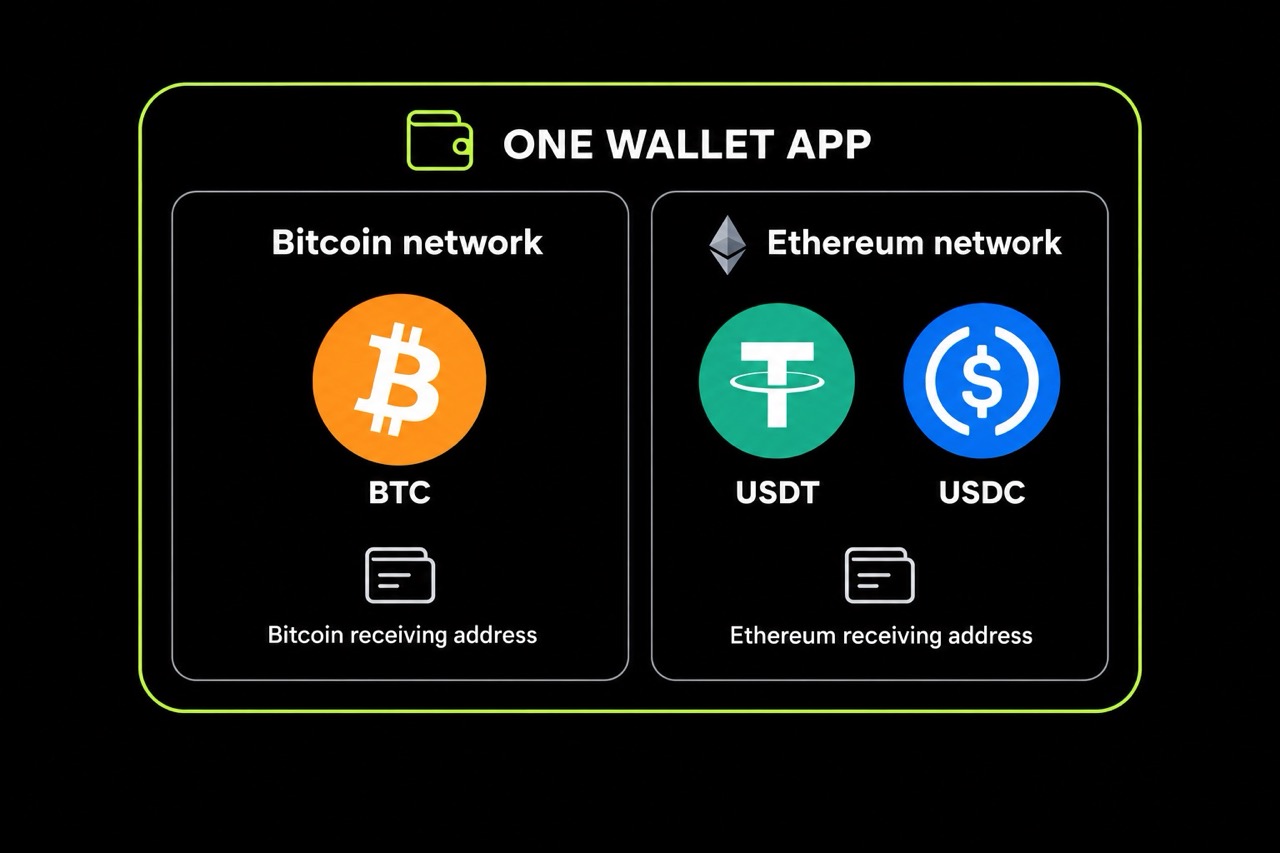
A wallet can manage Bitcoin and stablecoins in the same interface, while each asset remains on its own network. Ethereum is shown here as an example.
What about USDT and USDC on Bitcoin and Lightning?
Being able to manage these assets together does not mean you can send USDT through any Bitcoin or Lightning wallet. There are Bitcoin-related stablecoin projects, but using them requires support for the particular protocol involved, beyond the ability to receive BTC.
In recent years and months, Tether has also announced projects involving Taproot Assets, Lightning, and RGB, whose deployment and wallet compatibility need to be assessed separately. We will cover these integrations as they become available for practical use.
For USDC, Circle does not currently list Bitcoin's base layer among its native networks. If you want to keep BTC and USDC in the same application today, you can therefore do so through accounts on separate networks, without waiting for stablecoin support in your Bitcoin wallet's BTC account.
How do you spend stablecoins if you have no gas?
Once your wallet supports the token, choosing the receiving network is the next step. The sender must use that same network, even if your address looks identical across several Ethereum-compatible chains. Our page on swapping Bitcoin to USDC walks through this choice when converting BTC into a stablecoin balance.
Receiving USDC on Ethereum does not require you to own ETH, but an ordinary transfer out of that account does, because Ethereum charges transaction fees in ETH. You could therefore receive the entire amount successfully and only discover the problem when trying to pay someone. Keeping a small gas balance avoids having to find ETH at that point.
If you already have stablecoins but no gas, some services can help you obtain it from the balance you hold. On eligible routes, 1inch Fusion lets you swap a fraction of your tokens for the network's native fee token while another participant pays the execution fee. CoW Swap also offers gasless trading and signed approvals for eligible tokens, while MetaMask's gasless swaps can deduct fees from the asset being sold.
Availability depends on the token, network, and wallet configuration. As 1inch explains, an initial spending approval can still require gas when a signed approval is unavailable. Check this before relying on the service, and select the native gas token, such as ETH rather than WETH, since a gasless swap still has costs and must leave you with something you can actually use to pay fees.
What control do you keep over USDT and USDC?
Managing your own keys lets you send funds without asking an exchange to approve a withdrawal. However, USDT and USDC remain tokens issued by companies, whose reserves and ability to maintain the dollar peg you still depend on. Neither guarantees a permanent $1 market price.
Certain implementations also allow the issuer to freeze tokens in external wallets, as Circle describes in its USDC terms. Choosing self-custody removes the exchange from the custody relationship, but it does not remove the issuer or give its stablecoin Bitcoin's resistance to censorship.
The currency itself deserves consideration too. If your expenses are in euros, a dollar stablecoin still exposes you to changes in the dollar-euro exchange rate. Euro-denominated alternatives include Circle's EURC, Monerium's EURe, and SG-FORGE's EUR CoinVertible (EURCV), with the same need to check which networks your wallet supports.
Moving between Bitcoin and stablecoins with Satora
With a compatible wallet ready, you can convert BTC into a stablecoin balance without first depositing into an exchange account. Satora connects Bitcoin on-chain, Lightning, and Arkade with USDT, USDC, and other supported assets, with routes in both directions depending on the selected asset and network.
Satora uses self-custodial atomic swaps, where funds are locked under conditions that allow the exchange to complete or the sender to recover them if it cannot finish. The operator cannot freely take or redirect those funds, although recovery may require a waiting period and an action from the user. Our guide to how atomic swaps work explains these conditions in more detail.
You can choose a route in the Satora app, review the quote and fees, then fund the swap from your wallet. Once completed, the swap delivers the asset to the compatible wallet you selected.