Trade Bitcoin peer-to-peer at Lightning fast - HodlHodl integrates Satora swaps
Lightning trading is now live on HodlHodl Mainnet, powered by integrations with Arkade and Satora.
For Bitcoin peer-to-peer markets, this is more than a speed upgrade, it is a way to make small-value trades practical while preserving the core property that made HodlHodl different from custodial exchanges in the first place: users do not need to hand control of their BTC to a centralized platform.
Lightning Network trading is now live on HodlHodl, with trade limits ranging from $5 to $50. That range is exactly where this integration matters most: small, everyday transactions that were previously difficult to serve with on-chain escrow costs.
Why Bitcoin P2P trading needs escrow - and why bringing it to Arkade matters
Peer-to-peer Bitcoin trading has a simple but difficult coordination problem.
A buyer wants to receive Bitcoin. A seller wants to receive fiat or another agreed payment method. Neither side wants to trust the other blindly. The buyer should not pay first and hope the seller releases the BTC. The seller should not release BTC first and hope the buyer pays.
That is why escrow exists.
In a non-custodial P2P marketplace, escrow is the mechanism that lets 2 strangers trade without turning the platform into a custodian. Instead of having HodlHodl hold user funds in a centralized account, funds are locked into a Bitcoin multi-sig contract where release depends on the trade outcome:
- If everything goes well, the BTC is released to the buyer.
- If there is a dispute, the escrow logic gives the platform a role in arbitration without giving it unilateral control over funds.
Historically, this has worked well on Bitcoin, but it comes with an unavoidable cost: every purchase using escrows relies on 2 on-chain transactions. For larger trades, that cost can be acceptable, but for small trades, especially in emerging markets, it becomes a bottleneck.
Lightning solves a different problem, it is fast, cheap, and its invoicing protocols are broadly supported across the Bitcoin ecosystem. Wallets, payment tools, merchants, and users already understand the Lightning payment flow, but Lightning by itself is not a drop-in replacement for a programmable P2P escrow.
The Lightning Network is excellent for peer-to-peer payments, but it is not designed to replicate HodlHodl’s non-custodial escrow model on its own.
This is where Arkade becomes important.
Arkade, the first implementation of the Ark protocol, brings off-chain Bitcoin contracts to the trade flow. Instead of forcing every escrow action onto the Bitcoin blockchain, HodlHodl can use Arkade to create a fast, low-cost escrow environment while preserving the self-custodial guarantees users expect. Under the hood, funds can be represented and controlled through Arkade’s off-chain Bitcoin model, while still retaining Bitcoin-native security assumptions and unilateral exit paths.
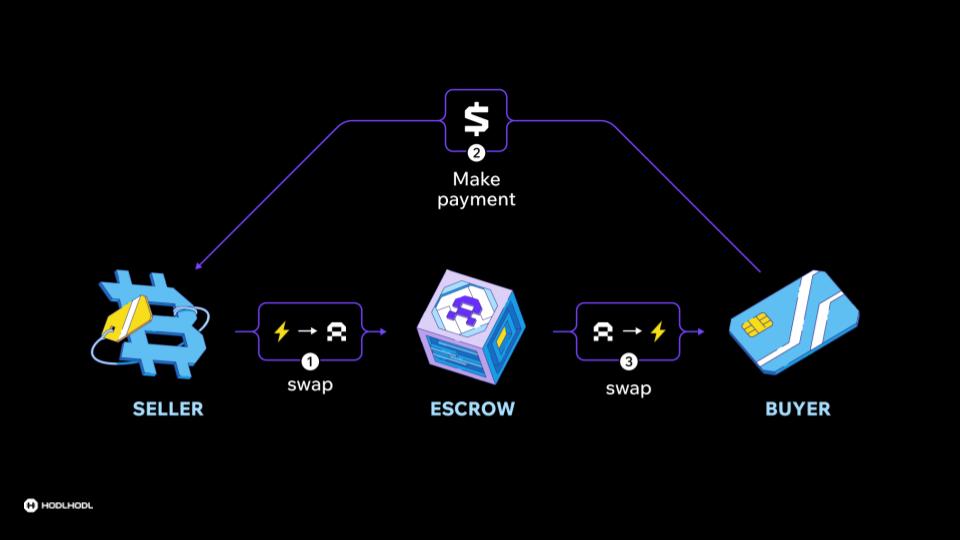
The result is a better architecture for P2P trading:
- Escrow remains non-custodial - users are not simply depositing funds into a centralized exchange wallet.
- Settlement becomes faster - the trade experience can move at Lightning speed.
- Small trades become viable - limits of $5 to $50 are now practical instead of being priced out by on-chain fees.
- The UX stays compatible with the Bitcoin ecosystem - users can interact through Lightning, the payment network already supported by every serious Bitcoin wallet.
This last point is essential, Arkade provides the escrow environment, but Lightning provides the interface to the broader Bitcoin economy. By connecting both, HodlHodl does not need to ask users to abandon familiar Lightning wallets or workflows.
Users can now access Lightning trading directly on Hodl Hodl.
Where Satora fits: the swap infrastructure between Lightning and Arkade
Satora’s role in this new feature is to make the Lightning ↔ Arkade transition happen without turning the trade into a custodial flow.
From the user’s perspective, the experience is simple: fund or receive a trade through Lightning, but behind that simple interface, the escrow itself lives in Arkade. That means the system needs a reliable way to move value between 2 different Bitcoin environments:
- Lightning, where the user sends or receives payment;
- Arkade, where the non-custodial escrow logic is executed.
Satora provides the atomic swap infrastructure that connects those 2 environments.
When a seller funds a HodlHodl Lightning trade, they can pay through Lightning, Satora coordinates the swap that moves the value into the Arkade escrow. When the trade is released, the reverse path makes it possible for the buyer to receive their satoshis through Lightning.
The important part is that this is not a custodial bridge, it's atomic swaps.
Satora swaps are built around atomic swap primitives such as HTLCs. In practical terms, this means the swap is conditional: either both sides of the exchange complete, or the flow can be safely unwound according to the timelock rules. Satora does not need unilateral control over user funds to perform its role, the infrastructure coordinates the transition between rails, but the security model remains enforced by cryptographic conditions rather than platform custody.
This is the core reason Satora exists: to make Bitcoin-native financial applications interoperable across the rails users actually use without ever introducing a third-party risk.
For our partner HodlHodl, that means:
- Lightning becomes the user-facing payment layer.
- Arkade becomes the escrow execution layer.
- Satora becomes the trustless swap layer connecting both.
Each component does what it is best at: Lightning brings reach, speed, and wallet compatibility, Arkade brings programmable off-chain Bitcoin escrow, and Satora brings the trust-minimized swap infrastructure that makes the 2 work together as a single product experience.
For end users, the result is straightforward: P2P Bitcoin trades that feel faster and lighter, without giving up self-custody.
For builders, it points to something larger, Bitcoin applications no longer need to choose between UX and non-custodial design. With the right swap infrastructure, applications can route value between Lightning, Arkade, on-chain Bitcoin, and other supported environments while keeping the user experience simple.
You can try Satora swaps directly at app.satora.io. For developers and integrators who want to understand the infrastructure in more detail, the technical documentation is available at docs.satora.io.